
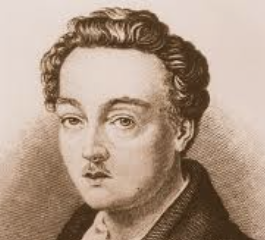
Georg Büchner — The Revolutionary Who Saw Modernity Coming (1813–1837)
Georg Büchner lived only twenty-three years, yet he wrote as if he had already seen the future. A scientist, political radical, and literary prodigy, he fused ruthless realism with lyrical intensity, exposing power, poverty, madness, and the fragility of human dignity. Büchner stands at the threshold of modern literature — a voice far ahead of his century.
Youth, Science, and Revolutionary Fire
Born in Goddelau, Germany, to a physician father, Büchner grew up immersed in anatomy, natural science, and Enlightenment rationalism. He studied medicine and zoology, producing serious scientific work even as his political conscience radicalized.
Appalled by social inequality and authoritarian rule, Büchner joined revolutionary circles and co-authored The Hessian Courier, a pamphlet denouncing tyranny with the unforgettable line: “Peace to the huts! War on the palaces!” The state responded swiftly. Warrants were issued, collaborators imprisoned, and Büchner fled into exile.
“The law is the property of a privileged class.”
Danton’s Death — Revolution Devours Itself
Büchner’s first major play, Danton’s Death, dismantles romantic views of revolution. Set during the French Revolution’s Reign of Terror, it portrays political idealism collapsing into paranoia, exhaustion, and moral despair.
Danton is not a heroic martyr but a man worn down by violence, aware that history grinds individuals without mercy. Büchner rejects moral simplifications: no side escapes guilt, and ideals offer no immunity from bloodshed.
“The revolution is like Saturn — it devours its own children.”
Woyzeck — Poverty, Power, and Madness
Woyzeck, left unfinished at Büchner’s death, is one of the most radical works ever written for the stage. Its fragmented scenes, abrupt shifts, and raw language anticipate modernist and expressionist drama by nearly a century.
The play follows a poor soldier exploited by authority, medical experimentation, and social humiliation. Woyzeck’s descent into madness is not presented as personal failure, but as the consequence of systemic cruelty. Büchner gives voice to those history usually silences.
“Every man is an abyss; one gets dizzy looking into it.”
Leonce and Lena — Comedy as Political Diagnosis
In Leonce and Lena, Büchner turned to comedy without abandoning critique. The play mocks empty aristocratic rituals, mechanical governance, and the absurdity of inherited power.
Beneath its fairy-tale surface lies a bleak insight: social roles operate automatically, while individuals drift through systems they barely comprehend. Humor becomes another lens for exposing alienation.
“We are automata, wound up and ticking.”
Materialism, Compassion, and the Body
Büchner’s scientific background shaped his philosophy. He rejected metaphysical consolations and idealist abstractions, insisting that human beings are embodied, vulnerable creatures shaped by material conditions.
Yet this realism never curdles into cynicism. His writing pulses with compassion for the suffering, the poor, and the mentally broken. Büchner saw clearly that morality divorced from material reality becomes hypocrisy.
“What is it that is called beauty? A word, a shell.”
Early Death and Immense Legacy
Büchner died of typhus in Zurich at twenty-three, leaving behind a body of work small in size but seismic in impact. He influenced naturalism, expressionism, Brecht, Kafka, and the entire trajectory of modern political theater.
His work refuses comforting narratives. History crushes, power corrupts, and suffering demands acknowledgment rather than explanation. Büchner remains a thinker for modernity — unsparing, compassionate, and devastatingly clear-eyed.
“The individual is nothing; history is everything.”
CivilSimian.com created by AxiomaticPanic, CivilSimian, Kalokagathia