
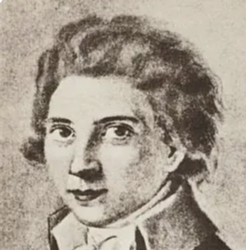
Friedrich Schlegel — Irony, Fragment, and the Infinite Conversation (1772–1829)
Friedrich Schlegel was philosophy refusing to sit still. He distrusted finished systems, preferred fragments to monuments, and treated thought as an ongoing experiment rather than a closed doctrine. More than almost anyone else, he helped invent Romanticism — not as a style, but as an attitude toward truth, art, and life itself.
A Restless Mind in a Revolutionary Age
Born into a cultured German family, Schlegel came of age during upheaval: the French Revolution, the aftershocks of Kant’s philosophy, and the collapse of classical certainties. He studied law and classical philology but quickly drifted toward literature, criticism, and philosophy — fields he refused to keep separate.
Alongside his brother August Wilhelm, Schlegel became a central figure of the Jena circle, collaborating with thinkers and poets such as Novalis, Schelling, and Schleiermacher. Their shared conviction was radical: philosophy should not dominate poetry, nor poetry submit to philosophy.
“Philosophy is the real home of irony.”
The Fragment — Thinking Without Closure
Schlegel’s most distinctive form is the fragment. Against the Enlightenment obsession with completeness, he argued that truth is never fully present. Any attempt to finalize it becomes dogma.
The fragment is not a failure to finish; it is a deliberate refusal to pretend that thought can end. Each fragment gestures beyond itself, inviting the reader into an unfinished dialogue. Philosophy becomes participation rather than instruction.
“A fragment, like a miniature work of art, must be entirely isolated from the surrounding world and complete in itself — like a hedgehog.”
Romantic Irony — Self-Awareness Without Cynicism
Schlegel’s concept of Romantic irony is often misunderstood. It is not sarcasm or detachment. It is the ability of a work — or a self — to remain conscious of its own incompleteness.
A truly free spirit, Schlegel thought, can create passionately while simultaneously knowing that creation is provisional. This double awareness prevents fanaticism without collapsing into nihilism.
“Irony is the clear consciousness of eternal agility, of an infinitely teeming chaos.”
Poetry, Philosophy, and the Infinite Task
Schlegel believed that poetry and philosophy were originally one activity — separated only by historical accident. Romanticism aimed to reunite them.
Poetry should think; philosophy should create. The highest works would blur the line entirely, producing a form of knowledge that is sensuous, reflective, playful, and open-ended. Truth, for Schlegel, is approached asymptotically — never possessed, always pursued.
“Romantic poetry is progressive, universal poetry.”
Conversion, Controversy, and Late Life
Later in life, Schlegel converted to Catholicism and took on a more conservative political stance — a move that alienated many admirers. Critics saw this as betrayal; others saw consistency in his refusal to remain fixed in one identity.
Even here, his thought resists simplification. Schlegel never abandoned the idea that life is an experiment in becoming — one that includes error, reversal, and contradiction.
Legacy — Philosophy as an Endless Conversation
Friedrich Schlegel shaped modern literary criticism, hermeneutics, and continental philosophy. He influenced Hegel, Kierkegaard, Nietzsche, Benjamin, and postmodern thought — especially where suspicion of total systems runs deep.
His enduring insight is simple and unsettling: thinking does not culminate in a final answer. It lives in dialogue, irony, and creative risk. Philosophy, like life, remains unfinished — and that is not a defect, but its freedom.
“To have a system is to lack integrity.”
CivilSimian.com created by AxiomaticPanic, CivilSimian, Kalokagathia