
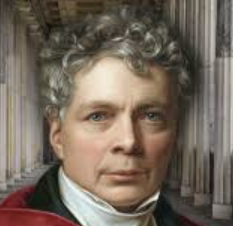
Friedrich Wilhelm Joseph Schelling — Nature Thinking Itself (1775–1854)
Schelling is philosophy at its most audacious — an attempt to think nature, freedom, art, and God as moments of a single living process. Too restless to remain within Kant’s limits, too wild to be absorbed by Hegel’s system, Schelling occupies a strange position: the philosopher who refused closure and paid the price in reputation.
Youthful Brilliance and Dangerous Proximity
Schelling entered philosophy at an almost absurd pace. A prodigy, he was publishing major works in his early twenties. At the Tübinger Stift he shared rooms, arguments, and revolutionary hopes with Hegel and Hölderlin. All three were intoxicated by Kant, the French Revolution, and ancient Greece.
Where Kant had drawn boundaries around reason, Schelling wanted to know what those boundaries were made of. He suspected that philosophy could not merely criticize knowledge; it had to explain how nature itself gives rise to mind.
“Nature is visible spirit; spirit is invisible nature.”
Nature as a Living Process
Schelling’s philosophy of nature was radical for its time. Nature is not dead matter passively obeying laws. It is productive, dynamic, and self-organizing — a continuous striving toward consciousness.
Magnetism, electricity, organic life, and thought itself are stages in one unfolding movement. Human reason is not imposed on nature from outside; it is nature finally becoming aware of itself.
“The system of nature is at the same time the system of our spirit.”
Art as the Revelation of the Absolute
For Schelling, art occupies a privileged position. Philosophy tries to think unity; science analyzes parts. Art, uniquely, *shows* unity directly. In the artwork, freedom and necessity, nature and spirit, unconscious production and conscious intention coincide.
This made art the highest expression of the Absolute — not a supplement to philosophy, but its completion. Romanticism found in Schelling its deepest metaphysical justification.
“Art is the true organ of philosophy.”
Freedom, Evil, and the Dark Ground of Being
Schelling’s later thought turns darker — and deeper. He confronts a problem Kant and Hegel avoided: how freedom can be real if everything is rationally necessary.
In his Philosophical Investigations into the Essence of Human Freedom, Schelling introduces a disturbing idea: being itself contains a ground that is irrational, blind, and will-like. Evil is not a defect in the system — it is a possibility rooted in existence itself.
“Without darkness there is no light.”
Overshadowed by Hegel
As Hegel’s system rose to dominance, Schelling’s refusal to finalize his thought was seen as weakness. Hegel accused him of dealing in vague intuition; history sided with the system-builder.
Yet when Hegelian confidence collapsed in the 19th century, thinkers returned to Schelling — finding in him a philosophy better suited to contingency, creativity, and existential risk.
Legacy — The Philosopher of Becoming
Schelling influenced Kierkegaard, Nietzsche, Heidegger, depth psychology, existentialism, and modern philosophy of nature. Wherever philosophy tries to think emergence, freedom, or creativity, Schelling waits in the background.
He remains the philosopher who refused to freeze reality into a diagram — who insisted that being lives, struggles, and risks itself. His work reminds us that any philosophy that eliminates mystery has misunderstood existence.
“The beginning of philosophy is not reason, but freedom.”
CivilSimian.com created by AxiomaticPanic, CivilSimian, Kalokagathia