
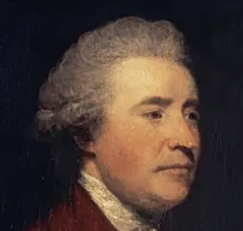
Edmund Burke — The Philosopher of Prudence, Tradition, and Political Limits (1729–1797)
Edmund Burke was the great skeptic of political abstraction — a thinker who believed that society is not a machine to be redesigned at will, but a fragile inheritance shaped by history, custom, and moral restraint. He stands as one of the founders of modern conservatism, not as an enemy of change, but as its most eloquent disciplinarian.
An Irish Outsider in the Heart of British Power
Born in Dublin to a mixed religious household — a Protestant father and Catholic mother — Burke grew up acutely aware of social division, power, and historical grievance. Educated at Trinity College, Dublin, he moved to London to pursue literature and politics, eventually entering Parliament where he would spend much of his adult life.
Burke was never merely a theorist. He was a working statesman, immersed in the practical realities of empire, law, and governance. His thought emerged from experience, debate, and political failure as much as from books. Philosophy, for Burke, was inseparable from responsibility.
“Politics ought to be adjusted, not to human reasonings, but to human nature.”
Tradition, Prejudice, and the Wisdom of the Unplanned
Burke’s most controversial idea was his defense of tradition and even “prejudice” — by which he meant inherited habits of judgment, not blind bigotry. Human societies, he argued, are too complex to be redesigned from first principles. Customs encode the hard-won knowledge of generations.
Abstract reason, when detached from lived experience, becomes dangerous. Burke believed that moral and political knowledge is distributed across time, embedded in institutions, rituals, and norms that no single generation fully understands. To destroy them lightly is to gamble with social collapse.
“Prejudice renders a man’s virtue his habit.”
The French Revolution — A Warning, Not a Celebration
Burke is best known for Reflections on the Revolution in France, a blistering critique of the revolutionary attempt to rebuild society on pure reason. While many Enlightenment thinkers celebrated the revolution, Burke saw in it the seeds of tyranny, violence, and moral disintegration.
He predicted that the destruction of monarchy, church, and aristocratic institutions would not lead to liberty, but to chaos followed by authoritarian rule. Events would largely vindicate his fears. For Burke, liberty required limits — moral, institutional, and historical.
“The people never give up their liberties but under some delusion.”
A Defender of Liberty — With Boundaries
Despite his reputation, Burke was no reactionary absolutist. He supported American colonial grievances, opposed the abuse of power by the British Crown, and led the impeachment of Warren Hastings for crimes in India. He believed deeply in justice, human dignity, and constitutional liberty.
What distinguished Burke was his belief that freedom survives only within stable institutions. Rights, he argued, are not abstract entitlements floating above history, but protections sustained by culture, law, and mutual obligation. Liberty without restraint destroys itself.
“Liberty, too, must be limited in order to be possessed.”
Society as a Moral Partnership Across Time
Burke famously described society as a partnership not only among the living, but between the dead, the living, and the unborn. This vision placed moral responsibility at the center of politics. Each generation is a steward, not an owner.
Progress, in this view, is real but fragile — achieved not through rupture, but through careful reform. Change should grow organically from what already exists, preserving what works while correcting what fails.
“Society is indeed a contract… not only of the living, but of the dead and the unborn.”
Legacy — The Conscience of Cautious Reform
Burke’s influence spans political theory, conservatism, and liberal constitutionalism. He remains a touchstone for those wary of utopian politics and centralized power. His thought shaped figures as diverse as Tocqueville, Oakeshott, and modern pluralists.
At his core, Burke reminds us that political wisdom is not brilliance but restraint — the humility to know that no generation is clever enough to redesign humanity. His legacy endures as a warning written in eloquence: that reason untethered from tradition can become its own form of madness.
“The only thing necessary for the triumph of evil is for good men to do nothing.”
CivilSimian.com created by AxiomaticPanic, CivilSimian, Kalokagathia