
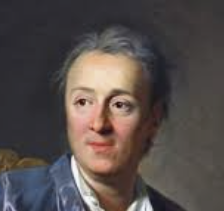
Denis Diderot — The Radical Mind Behind the Enlightenment’s Greatest Experiment (1713–1784)
Denis Diderot was the Enlightenment at full voltage — restless, irreverent, humane, and dangerously curious. He distrusted dogma wherever it appeared, whether in church, monarchy, or philosophy itself. More than a system-builder, Diderot was a catalyst: a thinker who sparked ideas, shattered certainties, and helped usher Europe into a new age of intellectual freedom. His legacy lies less in a single doctrine than in a fearless commitment to thinking aloud.
From Provincial Piety to Intellectual Revolt
Born in Langres, France, the son of a respected cutler, Diderot was initially destined for the priesthood. He received a rigorous classical and religious education, mastering theology and scholastic philosophy. But Paris changed him.
Immersed in the city’s vibrant intellectual life, Diderot drifted away from religious orthodoxy, embracing skepticism, materialism, and free inquiry. His early writings already showed the traits that would define him: wit, moral seriousness, and a refusal to accept inherited answers. These views would earn him censorship, imprisonment, and constant surveillance by the authorities.
“Man will never be free until the last king is strangled with the entrails of the last priest.”
The Encyclopédie — Knowledge as Revolution
Diderot’s defining achievement was the Encyclopédie, a monumental effort to gather, organize, and disseminate all human knowledge. Co-edited with the mathematician Jean le Rond d’Alembert, the project involved hundreds of contributors — philosophers, scientists, craftsmen, and artists.
The Encyclopédie was far more than a reference work. It was a subversive machine. By treating manual trades with the same dignity as theology, by embedding critiques of authority within technical articles, it quietly undermined traditional hierarchies of power. Knowledge, Diderot believed, should belong to everyone.
“The general will of the human race is enlightenment.”
Materialism, Nature, and the Thinking Body
Diderot rejected the sharp divide between mind and matter. Influenced by emerging biology and physiology, he argued that consciousness arises from material processes. Thought is not a divine spark injected into flesh — it is something living bodies do.
This materialism was not cold or mechanistic. Diderot saw nature as dynamic, creative, and self-organizing. Human beings, embedded within it, are capable of sympathy, imagination, and moral growth. Ethics, for Diderot, emerges from our shared vulnerability and capacity for feeling.
“We are instruments endowed with sensation and memory.”
Art, Morality, and the Experiment of Living
Diderot was also a pioneering art critic, novelist, and playwright. His writings on painting emphasized emotional truth and realism, rejecting rigid classical rules in favor of lived experience. In literature, he experimented with form, blurring the line between fiction, philosophy, and confession.
Works like Rameau’s Nephew explore moral ambiguity, social hypocrisy, and the tension between genius and virtue. Diderot did not offer tidy moral conclusions. He preferred dialogue, contradiction, and the messy reality of human life.
“Only passions, great passions, can elevate the soul to great things.”
Legacy — The Enlightenment’s Most Human Voice
Diderot died without seeing many of his most radical works published. Yet his influence is everywhere. He shaped secular humanism, modern aesthetics, and the democratic ideal of open knowledge. Later thinkers — from Marx to Foucault — recognized in him a forerunner of modern critical thought.
Diderot represents the Enlightenment at its most alive: skeptical but compassionate, scientific but imaginative, rebellious yet deeply concerned with human flourishing. He reminds us that philosophy is not only about systems — it is about the courage to think freely in public.
“Skepticism is the first step toward truth.”
CivilSimian.com created by AxiomaticPanic, CivilSimian, Kalokagathia