
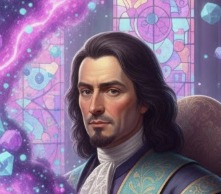
Sir Thomas Browne — The Anatomist of Wonder and Faith (1605–1682)
Sir Thomas Browne was a physician, philosopher, and literary alchemist who refused to choose between science and mystery. Writing at the dawn of modernity, he stood with one foot in the emerging scientific worldview and the other in a universe still shimmering with symbols, angels, and divine riddles. Browne explored not certainty, but wonder — and treated ignorance itself as a form of wisdom.
A Physician with a Metaphysical Pulse
Born in London and educated at Oxford and several continental medical schools, Browne trained as a physician at a time when medicine was shedding superstition and embracing observation. Yet he never accepted that empirical knowledge exhausted reality. He practiced medicine in Norwich for most of his life, quietly tending bodies while writing some of the strangest and most beautiful prose in the English language.
Browne lived amid civil war, religious fracture, and scientific upheaval. Copernicus had displaced the Earth, Bacon had challenged scholastic authority, and Descartes was mechanizing nature — but Browne resisted the flattening of the cosmos into mere machinery.
“Where there is mystery, it is generally supposed there must also be evil.”
Religio Medici — Faith Examined, Not Defended
Browne’s most famous work, Religio Medici (The Religion of a Doctor), was never intended for publication. It circulated privately before being printed without his consent — and promptly caused a sensation. The book is neither theology nor confession, but an anatomy of belief written by a scientifically trained mind unashamed of doubt.
Browne affirmed Christianity while rejecting dogmatism, intolerance, and certainty. He believed reason and faith were not enemies but imperfect allies — each limited, each necessary. Paradox, he argued, is not a flaw in belief but a feature of reality.
“I love to lose myself in a mystery, to pursue my reason to an O altitudo!”
Against Vulgar Errors — Skepticism with a Scalpel
In Pseudodoxia Epidemica, Browne attacked popular misconceptions — from mythical creatures to medical folklore — applying careful observation and classical scholarship. This was skepticism in service of clarity, not cynicism.
Yet even while debunking errors, Browne never mocked belief itself. He understood that humans live by symbols, myths, and habits of thought that reason alone cannot replace. Knowledge corrects error, but wonder sustains the soul.
“What song the Syrens sang, or what name Achilles assumed when he hid himself among women, though puzzling questions, are not beyond all conjecture.”
Death, Time, and the Shape of Eternity
Browne’s meditations on mortality are among his most enduring contributions. In Hydriotaphia, or Urn Burial, inspired by ancient funerary urns, he reflects on death, memory, and the fragility of human fame. Empires crumble; names fade; even monuments decay.
Yet Browne does not despair. Time erases, but eternity absorbs. Mortality humbles the ego and restores perspective. The universe, vast and indifferent, remains charged with sacred meaning.
“Man is a noble animal, splendid in ashes, and pompous in the grave.”
Style as Philosophy
Browne’s baroque prose is not ornament for its own sake. His winding sentences, layered metaphors, and Latinate rhythms mirror his worldview: reality is complex, indirect, and resistant to blunt explanation.
For Browne, how one writes reflects how one thinks. Precision without poetry is blindness; poetry without discipline is noise. Wisdom lives in the tension between clarity and mystery.
“There is no happiness within this circle of flesh.”
Legacy — The Last Man of the Enchanted World
Sir Thomas Browne stands at a crossroads in intellectual history. After him, the world becomes clearer — and colder. Before him, it was darker — but richer with symbols.
He reminds us that the rise of science need not annihilate wonder, and that skepticism need not dissolve reverence. Browne did not seek final answers — he sought a posture of humility before a universe that exceeds us.
“We carry within us the wonders we seek without us.”
CivilSimian.com created by AxiomaticPanic, CivilSimian, Kalokagathia