
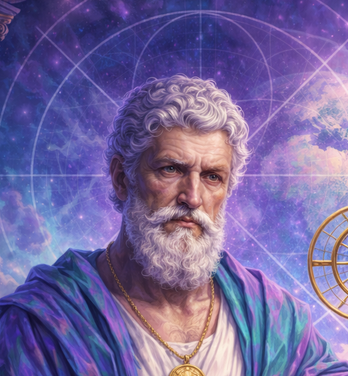
Thales of Miletus — The Man Who Asked What the World Is Made Of (c. 624–546 BCE)
Thales is remembered not for a system, a school, or a book, but for a single, revolutionary move: he sought to explain the world without appealing to myth. With him begins Western philosophy, science, and rational inquiry — the moment when nature became something to understand rather than appease.
The First Philosopher
Thales lived in Miletus, a wealthy Ionian city on the coast of Asia Minor, where trade, travel, and cultural exchange created fertile ground for new ideas. Unlike poets who explained the cosmos through quarrelling gods, Thales asked a quieter but far more dangerous question: What is the underlying nature of everything?
Aristotle later identified Thales as the first philosopher because he proposed a unifying principle of nature — an archê, a single underlying substance from which all things arise. This shift, from story to structure, marks the birth of philosophy and science alike.
“Thales was the first to seek a natural explanation of the cosmos.”
Water — The Origin of All Things
Thales proposed that everything ultimately comes from water. At first glance this seems naïve, but it was a bold abstraction. Water changes form — liquid, vapor, ice — nourishes life, and permeates the visible world. Thales was not making a poetic claim, but a proto-scientific hypothesis.
More importantly, his claim implied that nature operates according to internal principles, not divine whim. The world is intelligible, unified, and governed by regularity. Even when later thinkers rejected water as the fundamental substance, they inherited the method that made such questioning possible.
“Everything is full of gods.”
Science, Mathematics, and the Heavens
Thales was not only a philosopher but an early scientist. He is credited with predicting a solar eclipse in 585 BCE, a feat that astonished the ancient world and suggested that celestial events follow discoverable patterns.
He also introduced geometric principles from Egypt into Greek thought. Several basic theorems are attributed to him, including the idea that a circle is bisected by its diameter. Geometry, for Thales, was not abstract play — it was a way of measuring and mastering the world.
“The stars move according to reason, not caprice.”
Wisdom, Politics, and Practical Life
Thales was counted among the Seven Sages of Greece, admired not only for abstract thought but for practical wisdom. One famous story tells how he cornered the olive press market after predicting a good harvest — demonstrating that philosophers could be wealthy if they wished, but chose contemplation over profit.
This blend of theory and practicality would become a recurring ideal in Greek philosophy: the thinker not as an isolated dreamer, but as someone capable of understanding and navigating the real world.
“Know thyself — and know the world.”
Legacy — The First Step into Reason
Thales wrote nothing that survives. His legacy lies entirely in the question he dared to ask: What is the world made of, really? From that question flowed Anaximander, Anaximenes, Heraclitus, Parmenides, Plato, Aristotle — and eventually modern science.
Thales represents the first step away from myth and toward explanation. He stands at the dawn of reason, pointing not to the gods, but to nature itself, and saying: Look. Think. Understand.
“Philosophy begins the moment the world becomes a question.”
CivilSimian.com created by AxiomaticPanic, CivilSimian, Kalokagathia