
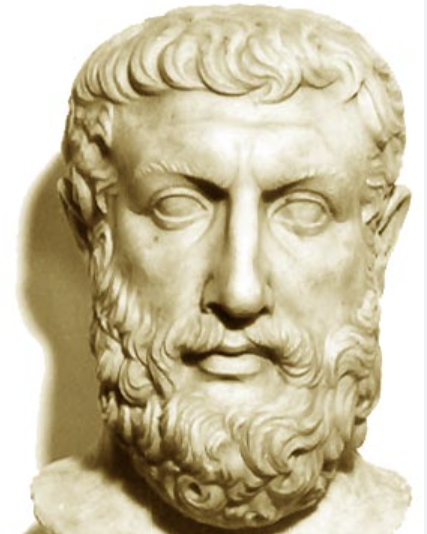
Parmenides — The Thinker Who Froze Reality into Being (c. 515–450 BCE)
Parmenides is one of the strangest and most consequential figures in Western thought. With a single, uncompromising argument, he declared that change, motion, plurality, and becoming are illusions. What truly exists, he claimed, is ungenerated, indestructible, motionless, and one. Philosophy has been arguing with him ever since.
A Philosopher from the Edge of the Greek World
Parmenides was born in Elea, a Greek colony in southern Italy, far from the intellectual centers of Athens and Ionia. Unlike many early philosophers, he was not primarily a scientist or cosmologist. His concern was deeper and more radical: what does it mean for something to be at all?
He wrote a single work, a philosophical poem usually called On Nature, fragments of which survive. Its poetic form is not decorative. Parmenides believed that the truth about reality was so severe, so counterintuitive, that it required mythic framing to be grasped.
“It is the same thing to think and to be.”
The Way of Truth vs. the Way of Opinion
Parmenides divides reality into two paths. The Way of Truth reveals what must be the case: Being is. Non-being is not. From this, he draws a ruthless conclusion: nothing can come from nothing, nothing can pass into nothing, and therefore change is impossible.
The Way of Opinion, by contrast, is the realm of everyday experience— birth and death, motion, difference, time. This world appears real to the senses, but it is fundamentally deceptive. Sense perception, for Parmenides, is a poor guide to reality.
“You cannot know what is not — that is impossible.”
Being — One, Eternal, and Unmoving
According to Parmenides, true reality is a single, continuous whole. It has no beginning and no end. It does not change, divide, grow, or decay. Any talk of coming-to-be or passing-away smuggles in non-being, which reason forbids.
Being is complete, self-identical, and timeless. The universe, properly understood, is not a process but a perfect, frozen totality. What looks like motion is a trick of perspective.
“What is, is ungenerated and imperishable.”
Reason Against the Senses
Parmenides is the first philosopher to explicitly privilege reason over perception. The senses tell us that the world changes. Reason tells us that change is impossible. When the two conflict, Parmenides sides with reason.
This move reshaped philosophy. It forced later thinkers to explain how change, plurality, and motion could be real without violating logical necessity. In a sense, all later metaphysics is damage control after Parmenides.
“Judge by reason the strife-filled proof I have spoken.”
Influence — The Problem That Never Went Away
Parmenides forced philosophy to grow up. Heraclitus defined himself against him. Plato treated him with reverence and anxiety. Aristotle struggled to rescue motion without surrendering logic. Even modern physics still grapples with questions that echo his insistence on unchanging being.
Whether accepted or rejected, Parmenides cannot be ignored. He showed that reality must answer to reason — even when reason contradicts everything we think we see.
“Being is; non-being is not.”
CivilSimian.com created by AxiomaticPanic, CivilSimian, Kalokagathia