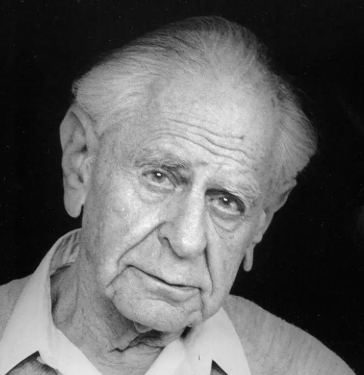
I appeal to the philosophers of all countries to unite and never again mention Heidegger or talk to another philosopher who defends Heidegger. This man was a devil. I mean, he behaved like a devil to his beloved teacher, and he has a devilish influence on Germany. ... One has to read Heidegger in the original to see what a swindler he was.
0
⚖0
▼Source
source
As quoted in "At 90, and Still Dynamic : Revisiting Sir Karl Popper and Attending His Birthday Party" by Eugene Yue-Ching Ho, in Intellectus 23
I think so badly of philosophy that I don't like to talk about it. ... I do not want to say anything bad about my dear colleagues, but the profession of teacher of philosophy is a ridiculous one. We don't need a thousand of trained, and badly trained, philosophers - it is very silly. Actually most of them have nothing to say.
0
⚖0
▼Source
source
As quoted in "At 90, and Still Dynamic : Revisiting Sir Karl Popper and Attending His Birthday Party" by Eugene Yue-Ching Ho, in Intellectus 23
It seems to me that I may be living too long. Indeed: my nearest relations have all died, and so have some of my best friends, and even some of my best pupils. However, I do not have a reason to complain. I am grateful and happy to be alive, and still be able to continue with my work, if only just. My work seems to me more important than ever.
0
⚖0
▼Source
source
As quoted in "At 90, and Still Dynamic : Revisiting Sir Karl Popper and Attending His Birthday Party" by Eugene Yue-Ching Ho, in Intellectus 23
There is an almost universal tendency, perhaps an inborn tendency, to suspect the good faith of a man who holds opinions that differ from our own opinions. ... It obviously endangers the freedom and the objectivity of our discussion if we attack a person instead of attacking an opinion or, more precisely, a theory.
0
⚖0
▼Source
source
"The Importance of Critical Discussion" in On the Barricades: Religion and Free Inquiry in Conflict (1989) by Robert Basil
Appealing to his [Einstein's] way of expressing himself in theological terms, I said: If God had wanted to put everything into the universe from the beginning, He would have created a universe without change, without organisms and evolution, and without man and man's experience of change. But he seems to have thought that a live universe with events unexpected even by Himself would be more interesting than a dead one.
0
⚖0
▼Source
source
As quoted in Omnipotence and Other Theological Mistakes by Charles Hartshorne
Before we as individuals are even conscious of our existence we have been profoundly influenced for a considerable time (since before birth) by our relationship to other individuals who have complicated histories, and are members of a society which has an infinitely more complicated and longer history than they do (and are members of it at a particular time and place in that history); and by the time we are able to make conscious choices we are already making use of categories in a language which has reached a particular degree of development through the lives of countless generations of human beings before us. . . . We are social creatures to the inmost centre of our being. The notion that one can begin anything at all from scratch, free from the past, or unindebted to others, could not conceivably be more wrong.
For it was my master who taught me not only how very little I knew but also that any wisdom to which I might ever aspire could consist only in realizing more fully the infinity of my ignorance.
Whenever a theory appears to you as the only possible one, take this as a sign that you have neither understood the theory nor the problem which it was intended to solve.
Scientists try to eliminate their false theories, they try to let them die in their stead. The believer-whether animal or man-perishes with his false beliefs.