
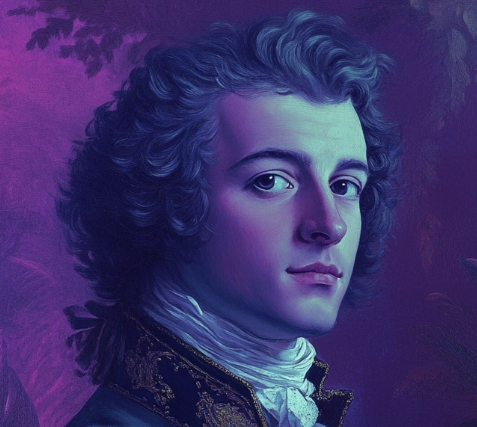
Jean-Jacques Rousseau — Philosopher of Freedom, Nature, and the Human Heart (1712–1778)
Rousseau challenged the foundations of society, arguing that humans are born free but everywhere find themselves constrained. His writings on politics, education, nature, and emotion lit the fuse of modern democracy and reshaped the way the Western world understands authenticity and individuality.
A Restless Life in Search of Truth
Born in Geneva and raised amid hardship, Rousseau developed a fierce independence of mind. He drifted across Europe as a young man, absorbing music, philosophy, and politics while wrestling with a deep sense of alienation and moral purpose. His early fame came not from politics but from his musical compositions and his prize-winning essays for the Academy of Dijon.
With the publication of the Discourse on the Origin of Inequality and later The Social Contract, he became a lightning rod in the intellectual world, admired and feared in equal measure. His personal life was tumultuous, marked by intense friendships, deep quarrels, and sudden flights from persecution.
“Man is born free, and everywhere he is in chains.”
Nature, Society, and the Corruption of Civilization
Rousseau famously argued that humans in the “state of nature” were peaceful, self-sufficient, and compassionate. It was society — with its competition, private property, and artificial hierarchies — that corrupted the human soul. His aim was never to send people back to the woods but to diagnose the sources of alienation and to imagine a community where freedom and equality could flourish together.
This critique of civilization electrified Europe. It called into question assumptions about progress and inspired reformers, revolutionaries, and educational thinkers for generations.
“The first person who, having enclosed a plot of land, thought of saying, ‘This is mine,’ and found people simple enough to believe him, was the true founder of civil society.”
The General Will and the Foundations of Democracy
In The Social Contract, Rousseau proposed that legitimate political authority arises not from kings or conquest but from the freely given consent of the people. He introduced the influential concept of the “general will” — the collective interest of citizens as equals, which legitimate laws must express.
Though often misunderstood, Rousseau’s political vision helped fuel the democratic movements of the late eighteenth century, including the French Revolution. His insistence that sovereignty belongs to the people remains central to modern republican and democratic thought.
“The moment a people gives itself representatives, it is no longer free.”
Education, Emotion, and the Inner Life
Rousseau revolutionized educational theory with Émile, arguing that children should learn through experience, curiosity, and direct engagement with the natural world. He insisted that emotion is not a weakness but a core part of human wisdom, and that a good education nurtures the whole person rather than training them to fit the machinery of society.
He also pioneered a new form of introspective writing in his Confessions, shaping modern ideas of personal authenticity, inner conflict, and psychological depth.
“To be sane in a world of madmen is itself madness.”
Legacy — Prophet of Democracy and the Modern Self
Rousseau reshaped politics, literature, psychology, and education. His vision of democracy as the expression of a free people helped lay the intellectual groundwork for modern constitutional states. His celebration of nature and authenticity inspired Romanticism and continues to influence environmental and psychological thought.
Few thinkers have spoken so directly to the tensions of modern life — between freedom and society, individuality and community, nature and civilization. Rousseau remains a guide for anyone trying to understand the human condition in a world of competing demands.
“What wisdom can you find that is greater than kindness?”
CivilSimian.com created by AxiomaticPanic, CivilSimian, Kalokagathia