
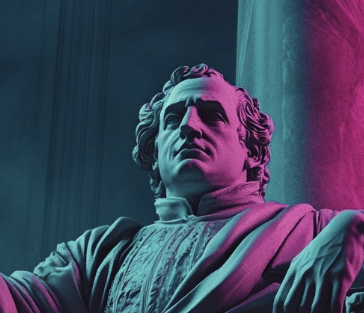
David Hume — Skeptic, Empiricist, and Master of the Human Mind (1711–1776)
Hume set out to understand the human mind with the precision of a scientist and the grace of a literary master. His radical skepticism, naturalism, and psychological insight reshaped philosophy, leaving a legacy that still shadows debates about knowledge, morality, and the self.
A Brilliant Mind Outside the Establishment
Born in Edinburgh, Hume grew up in a world steeped in religious authority and classical learning. Yet from an early age, he was drawn instead to reason, experience, and the workings of the mind. Rejecting a life in law, he plunged into philosophical study, producing the first draft of his monumental Treatise of Human Nature before he turned thirty.
The Treatise, though now considered a masterpiece, was initially ignored. Its failure did not slow him. Hume rewrote and refined his ideas in a series of essays that established him as a major intellectual force — witty, sharp, and disarmingly clear.
“Be a philosopher; but amidst all your philosophy, be still a man.”
Empiricism — All Knowledge Begins With Experience
Hume pushed empiricism — the idea that all knowledge comes from experience — to its limits. Every belief, he argued, can be traced back to impressions derived from the senses. Abstract ideas, metaphysical claims, and rationalist certainties all dissolve under scrutiny unless anchored in observable reality.
This method led him to challenge some of philosophy’s deepest assumptions, including the existence of innate ideas, the nature of causation, and the coherence of the self.
“A wise man proportions his belief to the evidence.”
The Problem of Causation — Habit, Not Necessity
Hume’s most famous challenge concerns causation. We assume that causes necessarily produce effects, but Hume argued we never perceive this necessity — only constant conjunction. We see A followed by B repeatedly, and the mind forms a habit of expectation.
This insight shook the foundations of science and metaphysics. Causation, for Hume, is a psychological pattern, not a metaphysical truth.
“Custom is the great guide of human life.”
Morality — Sentiment at the Center
Against rationalist moral theories, Hume argued that ethics is grounded not in pure reason but in sentiment — the feelings of approval and disapproval that arise naturally from human nature. Virtue, for Hume, is whatever promotes social cooperation, happiness, and mutual sympathy.
This view made him a pioneer of moral psychology, influencing later thinkers from Smith to Darwin to contemporary cognitive science.
“Reason is, and ought only to be, the slave of the passions.”
Religion, Miracles, and Skepticism
Hume’s cool, disciplined skepticism made him a formidable critic of religious claims. In his essay On Miracles, he argued that no testimony could ever justify belief in a violation of natural law unless its falsehood would be even more miraculous.
His naturalistic view of the world placed him at odds with religious authorities, though he himself maintained a gentle, moderate demeanor even when confronting sacred doctrines.
“The life of man is of no greater importance to the universe than that of an oyster.”
Legacy — The Philosopher Who Woke Kant
David Hume stands as one of the defining philosophers of the Enlightenment. His incisive critiques of causation, selfhood, and religion forced later thinkers to rebuild their theories from the ground up. Immanuel Kant famously said that Hume awakened him from his “dogmatic slumber.”
Hume’s blend of empiricism, skepticism, and psychological analysis continues to influence philosophy, economics, political theory, and cognitive science. His clarity and restraint remain a benchmark for intellectual rigor.
“Truth springs from argument amongst friends.”
CivilSimian.com created by AxiomaticPanic, CivilSimian, Kalokagathia