
This user has not added a profile. Civic duty awaits....
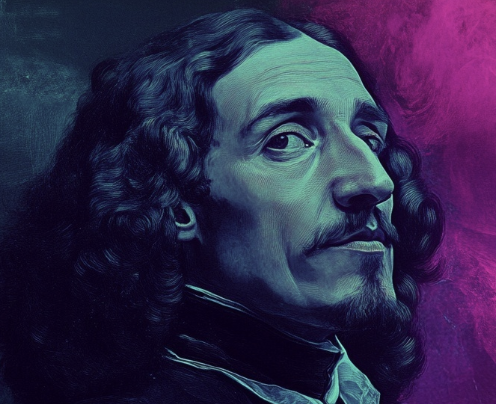
Baruch Spinoza — Philosopher of Infinite Substance and Radical Freedom (1632–1677)
Spinoza carved a dazzling, geometric vision of reality from pure thought. In a world torn by religious conflict, he dared to imagine a universe governed not by wrath or miracles, but by the serene, necessary order of nature — an infinite unity he called God.
A Life at the Edge of Tradition
Born in Amsterdam to a Portuguese-Jewish family fleeing persecution, Spinoza grew up in a tight-knit religious community. His relentless intellectual curiosity, however, drove him beyond traditional beliefs. By his early twenties he was formulating ideas so bold that he was excommunicated — an event that shaped both his independence and his solitude.
After his expulsion, Spinoza lived modestly, earning his living as a lens grinder while writing philosophical works of extraordinary ambition. His quiet life concealed a mind determined to rebuild philosophy from its foundations.
“The more we understand particular things, the more we understand God.”
God or Nature — The Infinite Substance
Spinoza’s metaphysics begins with a daring claim: there is only one substance in the universe, infinite and self-caused. Everything — every mind, every body, every star — is a mode of this single substance. He named it Deus sive Natura, “God or Nature,” not to blur the line between the divine and the world, but to reveal that the divine is the world, unfolding through necessary laws.
To understand reality is to see how every event arises from this infinite chain of causes. Freedom, in Spinoza’s universe, is not escape from necessity but clarity about it — the recognition that the self is part of a grand, unified order.
“Do not weep, do not wax indignant. Understand.”
The Human Mind — Ideas, Emotions, and Freedom
In his masterpiece, the Ethics, Spinoza describes human psychology with geometric precision. The mind, he argued, is the idea of the body, and emotions are the ways our power of acting increases or decreases. We are often enslaved by passions because we fail to grasp their causes.
But through reason — clear understanding of ourselves and the world — we can achieve a form of liberation. This is Spinoza’s route to happiness: a life guided by adequate ideas, grounded in reality rather than illusion.
“The highest activity a human being can attain is learning to understand, because to understand is to be free.”
Politics, Tolerance, and the Freedom to Think
Spinoza’s political writings championed freedom of thought, religious tolerance, and democratic principles long before they became mainstream. He believed that a stable state must allow its citizens to think and speak freely, for reason cannot flourish under coercion.
His Theological-Political Treatise was one of the most controversial books of the seventeenth century, challenging the authority of clergy and arguing that scripture should be interpreted historically rather than literally.
“In a free state, every man may think what he likes, and say what he thinks.”
Legacy — The Geometer of Reality
Spinoza died at forty-four, likely from lung damage caused by fine glass dust. Yet his influence has grown enormously over the centuries. He inspired Enlightenment thinkers, Romantic poets, radical democrats, neuroscientists, and modern philosophers who find in his ideas a startlingly contemporary vision.
His universe — unified, lawful, infinite — remains one of the most breathtaking metaphysical systems ever constructed. To read Spinoza is to encounter a mind trying to see the whole of reality with perfect clarity.
“All things excellent are as difficult as they are rare.”
CivilSimian.com created by AxiomaticPanic, CivilSimian, Kalokagathia