
3 months 1 week ago
For many, as Cranton tells us, and those very wise men, not now but long ago, have deplored the condition of human nature, esteeming life a punishment, and to be born a man the highest pitch of calamity; this, Aristotle tells us, Silenus declared when he was brought captive to Midas.
3 months 1 week ago
As Athenodorus was taking his leave of Cæsar, "Remember," said he, "Cæsar, whenever you are angry, to say or do nothing before you have repeated the four-and-twenty letters to yourself."
▼
Source
Cæsar Augustus
3 months 1 week ago
Lysander, when Dionysius sent him two gowns, and bade him choose which he would carry to his daughter, said, "She can choose best," and so took both away with him.
▼
Source
Of Lysander
3 months 1 week ago
Cato requested old men not to add the disgrace of wickedness to old age, which was accompanied with many other evils.
▼
Source
Cato the Elder
3 months 1 week ago
There are two sentences inscribed upon the Delphic oracle, hugely accommodated to the usages of man's life: "Know thyself," and "Nothing too much;" and upon these all other precepts depend.
3 months 1 week ago
"Young men," said Cæsar, "hear an old man to whom old men hearkened when he was young."
▼
Source
Cæsar Augustus
3 months 1 week ago
A physician, after he had felt the pulse of Pausanias, and considered his constitution, saying, "He ails nothing," "It is because, sir," he replied, "I use none of your physic."
▼
Source
Of Pausanias the Son of Phistoanax
3 months 1 week ago
He said they that were serious in ridiculous matters would be ridiculous in serious affairs.
▼
Source
Cato the Elder
3 months 1 week ago
To one commending an orator for his skill in amplifying petty matters, Agesilaus said, "I do not think that shoemaker a good workman that makes a great shoe for a little foot."
▼
Source
Of Agesilaus the Great
3 months 1 week ago
Socrates thought that if all our misfortunes were laid in one common heap, whence every one must take an equal portion, most persons would be contented to take their own and depart.
3 months 1 week ago
And when the physician said, "Sir, you are an old man," "That happens," replied Pausanias, "because you never were my doctor."
▼
Source
Of Pausanias the Son of Phistoanax
3 months 1 week ago
Cicero said loud-bawling orators were driven by their weakness to noise, as lame men to take horse.
▼
Source
Cicero
3 months 1 week ago
Antagoras the poet was boiling a conger, and Antigonus, coming behind him as he was stirring his skillet, said, "Do you think, Antagoras, that Homer boiled congers when he wrote the deeds of Agamemnon?" Antagoras replied, "Do you think, O king, that Agamemnon, when he did such exploits, was a peeping in his army to see who boiled congers?"
▼
Source
46 Antigonus I
3 months 1 week ago
Be ruled by time, the wisest counsellor of all.
▼
Source
Pericles (Tr. Dryden and Clough)
3 months 1 week ago
He made one of Antipater's recommendation a judge; and perceiving afterwards that his hair and beard were coloured, he removed him, saying, "I could not think one that was faithless in his hair could be trusty in his deeds."
▼
Source
40 Philip
3 months 1 week ago
To Harmodius, descended from the ancient Harmodius, when he reviled Iphicrates [a shoemaker's son] for his mean birth, "My nobility," said he, "begins in me, but yours ends in you."
▼
Source
54 Iphicrates
3 months 1 week ago
A prating barber asked Archelaus how he would be trimmed. He answered, "In silence."
▼
Source
33 Archelaus
3 months 1 week ago
Pyrrhus said, "If I should overcome the Romans in another fight, I were undone."
▼
Source
47 Pyrrhus
3 months 1 week ago
Rest gives relish to labour.
▼
Source
Of the Training of Children, 9 (Tr. Babbitt)
3 months 1 week ago
Being nimble and light-footed, his father encouraged him to run in the Olympic race. "Yes," said he, "if there were any kings there to run with me."
▼
Source
41 Alexander
3 months 1 week ago
Once when Phocion had delivered an opinion which pleased the people,... he turned to his friend and said, "Have I not unawares spoken some mischievous thing or other?"
▼
Source
55 Phocion
3 months 1 week ago
When Philip had news brought him of divers and eminent successes in one day, "O Fortune!" said he, "for all these so great kindnesses do me some small mischief."
▼
Source
34 Philip
3 months 1 week ago
Themistocles being asked whether he would rather be Achilles or Homer, said, "Which would you rather be,-a conqueror in the Olympic games, or the crier that proclaims who are conquerors?"
▼
Source
48 Themistocles
3 months 1 week ago
The great god Pan is dead.
▼
Source
Why the Oracles cease to give Answers (Tr. Goodwin)
3 months 1 week ago
When Darius offered him ten thousand talents, and to divide Asia equally with him, "I would accept it," said Parmenio, "were I Alexander." "And so truly would I," said Alexander, "if I were Parmenio." But he answered Darius that the earth could not bear two suns, nor Asia two kings.
▼
Source
42 Alexander
3 months 1 week ago
Phocion compared the speeches of Leosthenes to cypress-trees. "They are tall," said he, "and comely, but bear no fruit."
▼
Source
56 Phocion
3 months 1 week ago
There were two brothers called Both and Either; perceiving Either was a good, understanding, busy fellow, and Both a silly fellow and good for little, Philip said, "Either is both, and Both is neither."
▼
Source
35 Philip
3 months 1 week ago
He preferred an honest man that wooed his daughter, before a rich man. "I would rather," said Themistocles, "have a man that wants money than money that wants a man."
▼
Source
49 Themistocles
3 months 1 week ago
He is a fool who lets slip a bird in the hand for a bird in the bush.
▼
Source
Of Garrulity (Tr. Goodwin)
3 months 1 week ago
When he was wounded with an arrow in the ankle, and many ran to him that were wont to call him a god, he said smiling, "That is blood, as you see, and not, as Homer saith, 'such humour as distils from blessed gods.'"
▼
Source
43 Alexander
3 months 1 week ago
Valour, however unfortunate, commands great respect even from enemies: but the Romans despise cowardice, even though it be prosperous.
▼
Source
Aemilius Paulus 26 (Tr. Stewart and Long)
3 months 1 week ago
Lycurgus the Lacedæmonian brought long hair into fashion among his countrymen, saying that it rendered those that were handsome more beautiful, and those that were deformed more terrible. To one that advised him to set up a democracy in Sparta, "Pray," said Lycurgus, "do you first set up a democracy in your own house."
▼
Source
57 Lycurgus
3 months 1 week ago
Philip being arbitrator betwixt two wicked persons, he commanded one to fly out of Macedonia and the other to pursue him.
▼
Source
36 Philip
3 months 1 week ago
Alcibiades had a very handsome dog, that cost him seven thousand drachmas; and he cut off his tail, "that," said he, "the Athenians may have this story to tell of me, and may concern themselves no further with me."
▼
Source
50 Alcibiades
3 months 1 week ago
The mind is not a vessel that needs filling, but wood that needs igniting.
▼
Source
On Listening to Lectures (Tr. Waterfield)
3 months 1 week ago
Aristodemus, a friend of Antigonus, supposed to be a cook's son, advised him to moderate his gifts and expenses. "Thy words," said he, "Aristodemus, smell of the apron."
▼
Source
44 Antigonus I
3 months 1 week ago
Perseverance is more prevailing than violence; and many things which cannot be overcome when they are together, yield themselves up when taken little by little.
▼
Source
Sertorius 16 (Tr. Dryden and Clough)
3 months 1 week ago
Lysander said, "Where the lion's skin will not reach, it must be pieced with the fox's."
▼
Source
60 Lysander
3 months 1 week ago
Being about to pitch his camp in a likely place, and hearing there was no hay to be had for the cattle, "What a life," said he, "is ours, since we must live according to the convenience of asses!"
▼
Source
37 Philip
3 months 1 week ago
Being summoned by the Athenians out of Sicily to plead for his life, Alcibiades absconded, saying that that criminal was a fool who studied a defence when he might fly for it.
▼
Source
51 Alcibiades
3 months 1 week ago
Scilurus on his death-bed, being about to leave four-score sons surviving, offered a bundle of darts to each of them, and bade them break them. When all refused, drawing out one by one, he easily broke them,-thus teaching them that if they held together, they would continue strong; but if they fell out and were divided, they would become weak.
▼
Source
31 Scilurus
3 months 1 week ago
Thrasyllus the Cynic begged a drachm of Antigonus. "That," said he, "is too little for a king to give." "Why, then," said the other, "give me a talent." "And that," said he, "is too much for a Cynic (or, for a dog) to receive."
▼
Source
45 Antigonus I
3 months 1 week ago
Authority and place demonstrate and try the tempers of men, by moving every passion and discovering every frailty.
▼
Source
Comparison of Demosthenes and Cicero 3 (Tr. Dryden and Clough)
3 months 1 week ago
To one that promised to give him hardy cocks that would die fighting, "Prithee," said Cleomenes, "give me cocks that will kill fighting."
▼
Source
61 Cleomenes
3 months 1 week ago
"These Macedonians," said he, "are a rude and clownish people, that call a spade a spade."
▼
Source
39 Philip
3 months 1 week ago
Lamachus chid a captain for a fault; and when he had said he would do so no more, "Sir," said he, "in war there is no room for a second miscarriage." Said one to Iphicrates, "What are ye afraid of?" "Of all speeches," said he, "none is so dishonourable for a general as 'I should not have thought of it.'"
▼
Source
52 Iphicrates
3 months 1 week ago
Dionysius the Elder, being asked whether he was at leisure, he replied, "God forbid that it should ever befall me!"
▼
Source
32 Dionysius
3 months 1 week ago
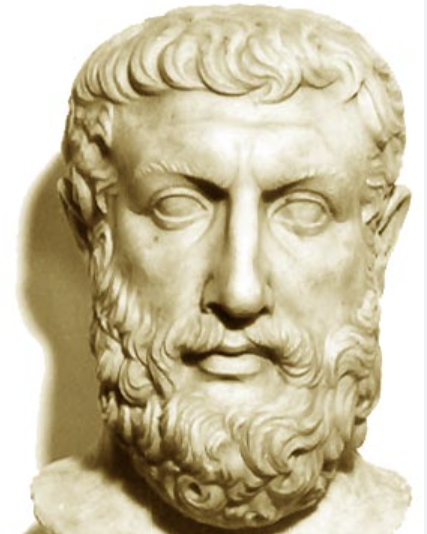
Never will this prevail, that the things that are not are - bar your thought from this road of inquiry.
▼
Source
Frag. B 7.1-2, quoted by Plato, Sophist, 237a
3 months 1 week ago
Do not let habit, born from experience, force you along this road, directing aimless eye and echoing ear and tongue; but judge by reason the much contested proof which I have spoken.
▼
Source
Frag. B 7.3-8.1, quoted by Sextus Empiricus, Against the Mathematicians, vii. 3
3 months 1 week ago
There is one story left, one road: that it is. And on this road there are very many signs that, being, is uncreated and imperishable, whole, unique, unwavering, and complete.
▼
Source
Frag. B 8.1-4, quoted by Simplicius, Commentary on the Physics, 144
CivilSimian.com created by AxiomaticPanic, CivilSimian, Kalokagathia